I want to write books that unlock the traffic jam in everybody’s head.
Writers may be disreputable, incorrigible, early to decay or late to bloom, but they dare to go it alone.
John Updike (1932-2009) was an American novelist, poet, and short story writer. In his generation, he was considered by many to be one of America’s most gifted writers of fiction.
Photo by u0410u043du043du0430 u0420u044bu0436u043au043eu0432u0430 on Pexels.com
Nothing just happens. You always have to strive.
Always look forward, never back.
Marcus Luttrell (born 1975) is a retired United States Navy Seal. In June, 2005, he was awarded the Navy Cross and Purple Heart for heroic actions in Afghanistan.
If you don’t have peace, it isn’t because someone took it from you; you gave it away. You cannot always control what happens to you,but you can control what happens in you.
From Isaiah 26:3: “Those of steadfast mind You keep in peace,in peace because they trust in You.”
John Maxwell (born 1947) is an American pastor, author, and speaker. He has written numerous books about leadership, with a Christian point of view.
From Psalm 46:1: “God is our refuge and strength,a very present help in trouble.”
Courtesy of Pinterest.
Raging storms now surround
Trusting Him in hard times
Always, God by my side
With each step, hope shall climb
Anchoring in His peace
Nurturing faith through grace
Always, God by my side
Love flows from heaven’s place
Rising every morning
Spending time in prayer
Always, God by my side
Comfort found in His care
Silencing each tempest
Shining countenance beams
Always, God by my side
Journey heading downstream
Leading with righteous truth
Hearing mercy’s voice
Always, God by my side
Faith accepts blessed choice
Escaping from bondage
Following perfect light
Always, God by my side
Sheltered at His campsite
Courtesy of Pinterest.
From Psalm 28:7: “The Lord is my strength and my shield;in Him my heart trusts; so I am helped, and my heart exults,and with my song I give thanks to Him.”
For the final Saturday of each month, a different and unique feature will be published. Today’s narrative takes a look at an impressive achievement from the Buckeye state of Ohio. Saturday’s regular feature, “Trivia’s Facts and More,” will return next week.
A native of Columbus, Ohio, Edward Vernon (Eddie) Rickenbacker lived a dynamic life in ways that few can imagine. His times filled up with feats of remarkable courage, dedication, and hard work.
Born to parents who were Swiss immigrants, Rickenbacker was born on October 8, 1890. Along with his six siblings, the family struggled to stay above water with their finances.
In 1904 at the age of 13, his father was killed in a construction accident. Realizing that his mother needed money, he dropped out of school to become the family’s breadwinner. This marked the beginning of Rickenbacker’s resolute attitude to make a difference. Others witnessed his unwavering, positive outlook over and over again throughout his life.
Rickenbacker loved working on machines and engines. This led to work as a mechanic, and later into automobile racing. He exhibited a fearless attitude as a driver, and he survived numerous close calls and accidents. In 1911, he competed in the inaugural Indianapolis 500, and he finished in 13th place.
left: prepared to race in the 1915 indy 500. right: restored rickenbacker family home in columbus, ohio. (images courtesy of pinterest)
As America entered World War I in 1917, Rickenbacker’s future destiny waited to be fulfilled. He joined the army and arrived in Europe where his first role was to serve as mechanic and driver for General John J. Pershing, commander of all American forces in Europe. What Sgt. Rickenbacker wanted most was to serve in the U.S. Army Air Service.
With encouragement from Colonel Billy Mitchell, a leading American advocate for tactical air power, he finished flight training in just 17 days. Lt. Rickenbacker was now prepared to serve his country as a fighter pilot. He was assigned to the 94th Aero Pursuit Squadron.
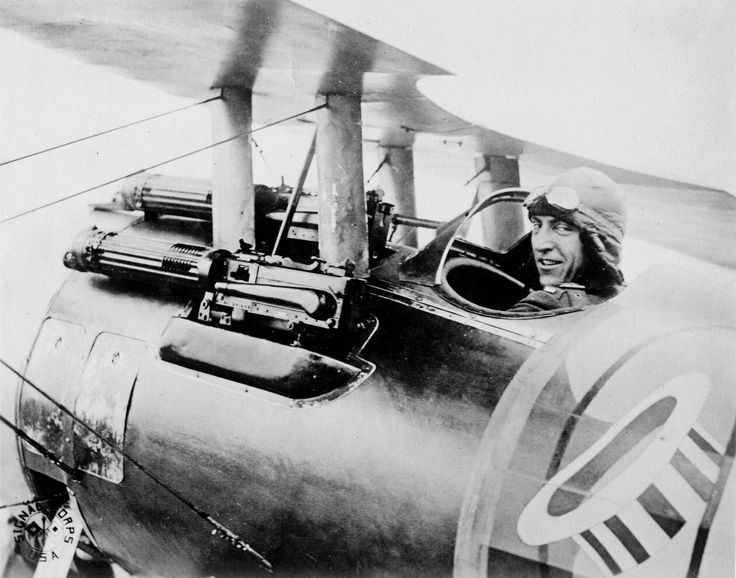
Just as he had proven to be a fearless race car driver, Rickenbacker accepted the challenges of air combat with the same “can do” attitude. He became a daring, yet gifted pilot. His prowess in aerial combat earned “Captain Eddie” the Medal of Honor in recognition of his 134 combat missions and 26 air victories, the highest of all American pilots. Nicknamed the “Ace of Aces,” he was recognized as the most celebrated American fighter pilot of the war.
Upon being promoted to Captain of the 94th Aero Pursuit Squadron, Rickenbacker impressed upon his pilots that an experienced fighting pilot did not have to take unnecessary risk. It was a pilot’s business to shoot down enemy planes, not to get shot down.
left: closeup of lt. rickenbacker. right: sitting in the cockpit of his fighter. (Images courtesy of Pinterest)
Following the war, Rickenbacker turned his attention to a variety of pursuits. He briefly owned a car manufacturing company before financial troubles closed its operations. He purchased the Indianapolis Speedway in 1927, and he owned it until 1945.
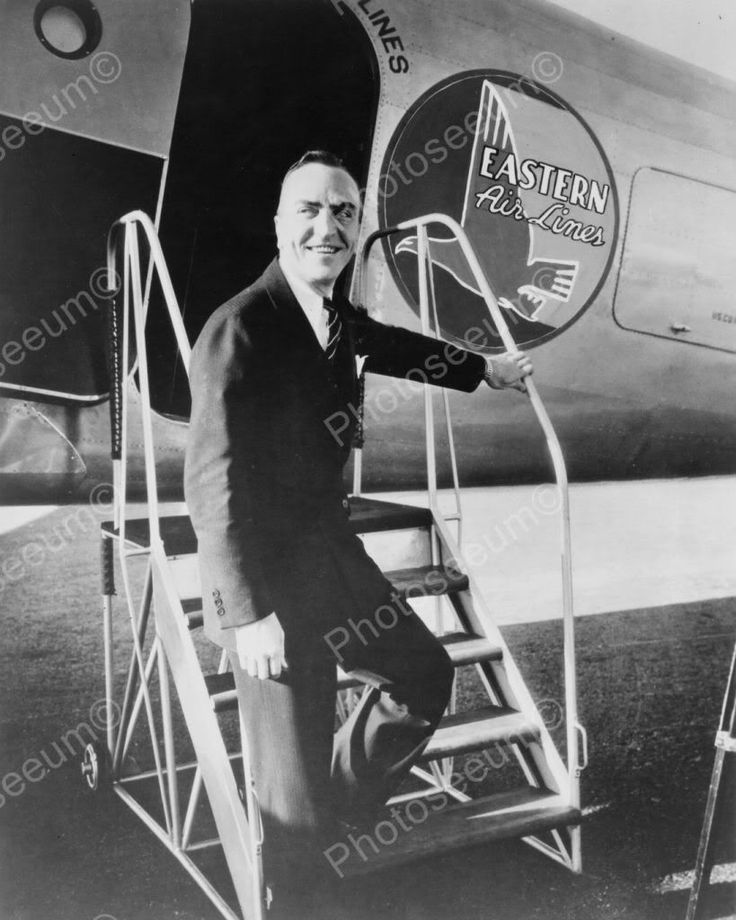
In 1938, he bought Eastern Air Lines, and turned it into one of the most profitable airlines during the 1940s and 1950s. He remained in a leadership position until he retired in 1963.
Two significant events further sealed the legend of Eddie Rickenbacker. While traveling on a civilian plane on February 26, 1941, he along with a few other passengers survived a crash. Both pilots and 11 passengers were killed. Rickenbacker sustained serious injuries: shattered pelvis, broken ribs, broken leg, and a torn eyelid. After several days in the hospital, he made a total and miraculous recovery.
During World War II, Rickenbacker became an eager volunteer and supporter of American troops. He toured numerous Army Air Corps bases to boost morale and inspect methods of training. One more brush with death waited for him in the South Pacific.
Aboard a B-17 flying fortress in October, 1942, Rickenbacker was enroute to New Guinea to deliver a message to American General Douglas MacArthur. Unfortunately, the plane crashed into the Pacific Ocean a few hundred miles off course. Rickenbacker and seven other men attempted to survive while floating in rubber rafts. Forgotten for 24 days, they lived on rainwater and fish. With Rickenbacker’s leadership and encouragement, only one of the men would perish. A leading American newspaper, The Boston Globe, described him as “The Great Indestructible.”
left: standing next to his world war I fighter. right: President of eastern air lines. (Images courtesy of Pinterest)

Success is not the result of spontaneous combustion. You must set yourself on fire.
Courage is doing what you’re afraid to do. There can be no courage unless you’re scared.
Eddie Rickenbacker (1890-1973) was an American combat pilot, race car driver, and business executive. Born in Columbus Ohio, he became America’s top flying ace during World War I.
The vision of God is the source of patience, because it imparts a moral inspiration.
From Habakkuk 2:3: “For there is still a vision for the appointed time;it speaks of the end and does not lie. If it seems to tarry, wait for it;it will surely come; it will not delay.”
Oswald Chambers (1874-1917) was a Scottish evangelist and Christian teacher. Following his death from an illness while in Egypt during World War I, his wife took on the task of transcribing the detailed notes she had written from his lectures and sermons. Gertrude Hobbs Chambers’ efforts resulted in the publication in 1924 of MY UTMOST FOR HIS HIGHEST. I frequently read from this devotional, and it has greatly deepened my faith and understanding of God’s Word.
From 1 Corinthians 13:4-7: “Love is patient; love is kind; love is not envious or boastful or arrogant or rude. It does not insist on its own way; it is not irritable; it keeps no record of wrongs; it does not rejoice in wrongdoing but rejoices in the truth. It bears all things, believes all things, hopes all things, endures all things.”
The man who tried his best and failed is superior to the man who never tried.
Bud Wilkinson (1916-1994) was an American college football coach and broadcaster. From 1947-1963, he served as the head coach at the University of Oklahoma, and his teams won three national titles and 14 conference championships.
For the final Saturday of each month, a different and unique feature will be published. Today’s narrative takes a look at the accomplishments of American poet Phillis Wheatley. Saturday’s regular feature, “Trivia’s Facts and More,” will return next week.
A select few face overwhelming challenges in life. Encouraged by a heart filled with perseverance, these trailblazers adopt an attitude where “Can” outplays “Can’t.”
Facing upheaval in her young life, Phillis Wheatley manages to overcome in a journey few can ever imagine. Born around 1753, she becomes the world’s first African-American author with published works. However, her story needs to be told from the beginning.
Coming to the American colonies in 1761, this young girl enters the slave trade. Leaving her West African home, her tender life is uprooted.
She is purchased as a domestic slave for a New England merchant’s wife. Without realizing it at the time, John and Susanna Wheatley will soon transform Phillis’ life.
Phillis’ name is taken from the slave ship which brought her to America, the Phillis. She later adopts her last name from the Wheatley’s.
The Wheatley’s daughter, Mary, begins teaching Phillis to read and write. Her brother, Nathaniel, also helps to tutor Phillis as well.
Seeing potential in the young Phillis’ eagerness to learn more, John Wheatley offers her an academic journey beyond anything most American slaves will ever experience. Beginning at age 12, she is studying Greek and Latin, learning history and geography, and reading the Bible.
By the age of 14, Phillis writes her first poem, and she continues to write many more. The Wheatley’s free her from domestic duties so that she can further her studies. Following the death of Susanna Wheatley, Phillis will be granted freedom.
Quote from Phillis Wheatley:
“In every human breast, God has implanted a principle, which we call Love of Freedom; it is impatient of oppression, and pants for deliverance.”
In 1773, Phillis journeys to London with Nathaniel. In their search for a publisher of her poems, the two of them find an interested party. Upon publishing her book of poetry, readers in England and the American colonies discover her poetry. Even George Washington reads her poems, and Phillis will later meet him.
In Phillis’ final years, she marries a free black man, John Peters. He toils as an unsuccessful entrepreneur, and his children and wife endure a life filled with poverty. During this time, Phillis continues to write, but none of these works will be published. She dies in 1784.
Phillis Wheatley’s only book of published poetry, Poems on Various Subjects, Religious and Moral, was published in 1873. Before having her poetry published, she needed to provide evidence that she was the writer. After all, slaves in America usually did not know how to read and write, much less write classical poetry.
Here is a sample of her poetry, “On Being Brought from Africa to America” (published 1773):
“Twas mercy brought me from my Pagan land,
Taught my benighted soul to understand
That there’s a God, that there’s a Savior too:
Once I redemption neither sought now knew,
Some view our sable race with scornful eye,
‘Their colour is a diabolic die’
Remember, Christians, Negroes, black as Cain,
May be refin’d, and join ‘th’ angelic train.
Courtesy of Pinterest.
Previous editions of other narratives of “Overcoming Life’s Insurmountable” can be found from the links below.