Faith makes the discords of the present the harmonies of the future.
From Jeremiah 29:11: “For surely I know the plans I have for you, says the Lord, plans for your welfare and not for harm, to give you a future with hope.”
Robert Collyer (1823-1912) was an English-born pastor. Early in his adult life, he emigrated to the United States and would later resuming preaching after having done so in England.
From Isaiah 7:14: “Therefore the Lord Himself will give you a sign. Look, the young woman is with child and shall bear a son and shall name Him Immanuel.”
Courtesy of Pinterest.
God’s plan of redemption
Viewed through love’s transforming scope
Faithful virgin shall bear His Son
Fulfilling flame of eternal hope
God’s warm heart offers love
Promised Prince at Heaven’s gate
Empty darkness shall fill with joy
Breathing from cold, humble stable’s fate
God’s peace nurtures man’s trust
Filled with mercy’s lasting grace
Sacred Word witnessed in Son’s flesh
Living waters share love to embrace
God’s creation speaks truth
Blessed news fills shepherds’ ears
Advent’s greatest virtue breathes love
Silencing night, morning’s sun appears
Light born in Bethlehem
Delivered hope sharing peace
Angels’ unbelievable joy
Praising Savior’s love, shall never cease
Courtesy of Pinterest.
Advent Prayer: Heavenly Father, as we remember and reflect upon this Advent season, assist us in turning our hearts toward You as we approach the birth of Your blessed Son. Encourage us to celebrate the gifts received from that very first Christmas: hope, peace, joy, and love. Amen.
The final hymn of this Advent series comes from the inspiration of American pastor and Christian writer Phillips Brooks. Recalling his 1865 trip to Bethlehem, he wrote the lyrics for “O Little Town of Bethlehem” in 1868.
There will be moments when harmony’s carousel seems in need of a tune-up. Always in charge, God reminds us that He alone will calm the noise around us.
Do you write a daily journal? This inspiring thought comes from my journal, and much of what is written in my journal comes from reading and commenting on other bloggers’ posts. Thanks to many of you for adding so much to my journal.
For the Christ-child who comes is the Master of all; no palace too great, no cottage too small.
From Matthew 2:6: “And you, Bethlehem, in the land of Judah,are by no means least among the rulers of Judah, for from you shall come a rulerwho is to shepherd my people Israel.”
Phillips Brooks (1835-1893) was an American pastor and Christian author. He was remembered for his charismatic preaching as well as writing the lyrics of the beloved Christmas hymn, “O Little Town of Bethlehem.”
This informative post will be published on Saturday in place of my regular one. You are invited to participate with the opening question.
Brain Teaser Question
Besides the most famous reindeer of all, Rudolph, can you name Santa’s eight remaining reindeer?
(answer found at the end of this post)
Featured Facts
One of the most popular songs at Christmas is “Rudolph the Red-Nose Reindeer.” People know bits and pieces about the history behind the song; but, here is the rest the story.
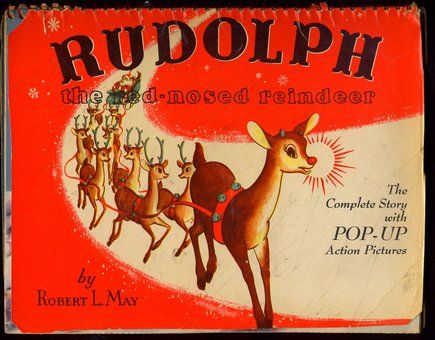
In the late 1930s, American retailer Montgomery Ward was looking to create a nationwide marketing campaign for the month of December. They looked for help from their talented copywriter, Robert L. May.
As May crafted poetry to share the story of his newly invented character, Rudolph, he enlisted the help of Denver Gillen. Gillen worked in Montgomery Ward’s art department, and his illustrations would be featured in the short publication.
While Gillen envisoned Rudolph as a young deer with his big, red nose, May crafted rhyming couplets (a sample follows).
Twas the day before Christmas, and all through the hills
The reindeer were playing, enjoying the spills
Of skating and coasting, and climbing the willows
And hopscotch and leapfrog (protected by pillows)
Over 800 Montgomery Ward stores opted in to participate in the December promotion. Nearly two and a half million copies were ordered (at at cost of 1.5 cents apiece). The copies were given freely to children who visited each participating store.
Following World War II in 1949, Montgomery Ward decided to bring back their highly successful Christmas promotion, which again featured “Rudolph the Red-Nosed Reindeer.” Over three and a half million copies were printed.
Eventually Montgomery Ward granted May the copyright privileges to “Rudolph the Red-Nosed Reindeer.” He shared his poetry story with his brother-in-law, Johnny Marks. Marks just happened to be a songwriter. With May’s approval, he adapted the story to lyrics of a Christmas song of the same name.
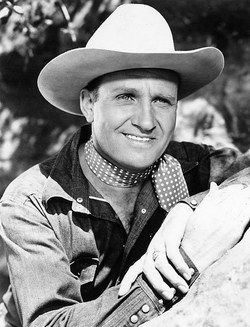
Actor and singing cowboy, Gene Autry, was signed to record the song, and it became a top hit in 1946. The lyrics featured an updated story about this famous reindeer. Later in 1964, television’s classic animated feature, “Rudolph the Red-Nosed Reindeer,” was produced by Rankin/Bass.
Moving from top left and clockwise: cover of one version of Robert L. May’s book, Robert L. May, Gene Autry, scene from television’s 1964 feature, gene autry’s album cover. (Images courtesy of Pinterest)
As images of the Christmas season slowly fade away, we try to hang on to the final ones before they just seem to melt away.
Do you write a daily journal? This inspiring thought comes from my journal, and much of what is written in my journal comes from reading and commenting on other bloggers’ posts. Thanks to many of you for adding so much to my journal.
Gene Autry with his horse Champion. (courtesy of Pinterest)
Gene Autry (1907-1998) was an American actor and singer. Most of his roles in film and television revolved around his love of the West and the American cowboy. During the 1940s, he wrote up his “Cowboy Commandments.”
The Cowboy must never shoot first, hit a smaller man, or take unfair advantage.
He must never go back on his word, or a trust confided in him.
He must always tell the truth.
He must be gentle with children, the elderly, and animals.
He must not advocate or possess racially or religiously intolerant ideas.
He must help people in distress.
He must be a good worker.
He must keep himself clean in thought, speech, action, and personal habits.
He must respect women, parents, and his nation’s laws.
This series of poems (written in the German-inspired style of Elfchen or Elevenie) shares a total of eleven words in each poem, with a sequence by line of one, two, three, four, and one words.
Even when life deposits darkness at our doorstep, God will nourish our faith in order for us to witness tomorrow’s light.
Do you write a daily journal? This inspiring thought comes from my journal, and much of what is written in my journal comes from reading and commenting on other bloggers’ posts. Thanks to many of you for adding so much to my journal.
God’s work is not in buildings, but in transformed lives.
From Matthew 3:2: “Repent, for the kingdom of heaven has come near.”
Ruth Bell Graham (1920-2007) was an American Christian author. Born to American parents who were dedicated to medical missionary work in China, she would later become the wife of evangelist Billy Graham. They met when both were attending Wheaton College in Illinois.











 Big Sky Buckeye