Born in the Big Sky Country of Montana and now living in the Buckeye State of Ohio, Richard is the creative mind behind Big Sky Buckeye. Retired after 40 years of teaching, I enjoy writing, photography, traveling, and following a healthy lifestyle.
God is not fooled by good behavior that springs from a hard heart. Obeying Him with an unwilling spirit may achieve His purpose, but we lose the joy of our reward.
From Jonah 4:9-11: “But God said to Jonah, ‘Is it right for you to be angry about the bush?’ And he said, ‘Yes, angry enough to die.’ Then the Lord said, ‘You are concerned about the bush, for which you did not labor and which you did not grow; it came into being in a night and perished in a night. And should I not be concerned about Nineveh, that great city, in which there are more than a hundred and twenty thousand persons who do not know their right hand from their left and also many animals?'”
A select few face overwhelming challenges in life. Encouraged by a heart filled with perseverance, these trailblazers adopt an attitude where “Can” outplays “Can’t.”
Born in 1786, young James Holman joined the British navy at age 12 during Europe’s Napoleonic Wars. He became an accomplished sailor and rose to the rank of lieutenant.
When he reached the age of 25, his life faced the insurmountable. Serving with the navy during the War of 1812 (British-American conflict), he contracted severe rheumatism. Unable to overcome the pain in his legs, ankles, and feet, Holman could barely walk. Eventually, the illness caused him to lose his eyesight.
Due to his blindness, he was awarded an act of royal charity. Joining the Knights of Windsor, he received a pension and residence at Windsor Castle. He was expected to live quietly there until his eventual death.
Holman was never content to sit idly and watch his life decline year by year. He refused to live as an isolated invalid, and he moved to Edinburgh, Scotland to attend medical school.
Queen Victoria’s own doctor backed up Holman’s need to be free from the confines of Windsor Castle. His painful rheumatism responded well to healing sunshine from continuous travel’s change of scenery and climate.
Holman’s time at Edinburgh motivated him to travel the world and fill his days with curiosity and fun. In 1819, he began his first journey to Europe, and he continued this quest over the next four decades. Traveling unaccompanied, he always traveled solo.
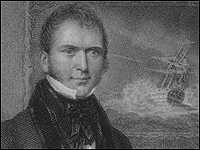
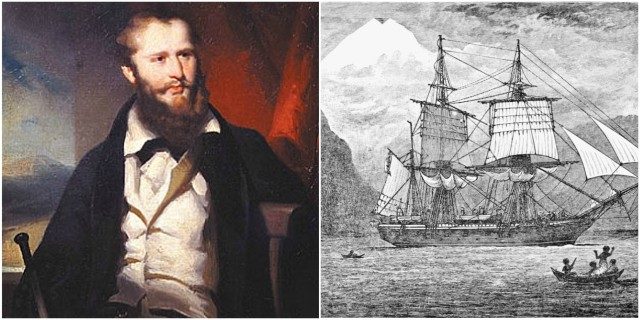
Left: A young James Holman from his naval days (courtesy of NPR). Right: A mature Holman with a full-grown beard (courtesy of Vintage News).
His first foreign travels took him to France. With little money, unable to speak the native language, and blind, Holman found his life’s purpose. His own words described his initial travels: “Behold me, then, in France! Surrounded by a people, to me, strange, invisible, and incomprehensible.”
By 1832, he had completed circumnavigation of the globe. By 1846, he had visited every inhabited continent. It was calculated that he traveled an estimated 400,000 kilometers. His metal-tipped walking stick was a constant companion.
Many adventures awaited Holman over the years. In Russia, he was imprisoned and later exiled as a spy. In Africa, he was involved in actions against the slave trade.
In his later years, Holman compiled memoirs of his travels. Five volumes would eventually be published, but most were not widely read.
Following his death in 1857, Holman’s life moved to obscurity. His adventures were long forgotten, but this would change.
In 2006, author James Roberts published a biography of Holman’s life and travels in A Sense of the World: How a Blind Man Became History’s Greatest Traveler.
People once again discovered the man known as the “Time Traveler.”
For more details about Holman’s extraordinary life, here is a link to more: Explorers Web.
This informative post will be posted on Saturday along with my usual writing. You are invited to participate with the opening question.
Brain Teaser Question
If a doctor gives you three pills, telling you to take one very half hour, how many minutes will pass from taking the first pill to the last pill?
(answer found at the end of this post)
Featured Facts
The Cornhusker State of Nebraska entered the American Union on March 1, 1867. Following the end of the American Civil War, the Nebraska Territory was the first one granted admission to statehood.
While the city of Omaha has been the most populated one in the state, Lincoln has been the capital city. According to the 2022 U.S. Census, Omaha’s population stood at 486,051 while Lincoln’s was 291,082.
Here are a few interesting facts about Nebraska:
State Bird: Western meadowlark
State Flower: Goldenrod
State Motto: Equality Before the Law
Chimney Rock, located in northwestern Nebraska at Deadwood Gulch, was one of the most noted landmarks on the Oregon Trail. The Nebraska Legislature has been the only one in the United States to use a single house chamber (unicameral). The original nickname for the state was the “Tree Planter’s State.”
Left: Chimney Rock. Right: The football Cornhuskers’ Memorial Stadium on the University of Nebraska campus. (Courtesy of Pinterest)
While the novelist is banging on his typewriter, the poet is watching a fly in the windowpane.
The trouble with poetry is that it encourages the writing of more poetry.
Billy Collins (born 1941) is an American poet who served as America’s Poet Laureate from 2001 to 2003. He has published several collections of his poetry.
Where the soul is full of peace and joy, outward surroundings and circumstances are of comparatively little account.
From John 14:27: “Peace I leave with you; My peace I give to you. I do not give to you as the world gives. Do not let your hearts be troubled, and do not let them be afraid.”
Hannah Whitall Smith (1832-1911) was an American lay speaker and Christian author. She was an active voice during the women’s suffrage movement as well as the temperance movement in the United States.
William Stanley Merwin (W. S.) was an American poet with over 50 books of poetry and prose. Over his lifetime (1927-2019), he was honored with numerous awards: including the Pulitzer Prize for Poetry (1971 and 2009) and becoming United States Poet Laureate in 2010.
From Colossians 3:12: “Therefore, as God’s chosen ones, holy and beloved, clothe yourselves with compassion, kindness, humility, meekness, and patience.”
From Colossians 3:13-14: “Bear with one another and, if anyone has a complaint against another, forgive each other; just as the Lord has forgiven you, so you also must forgive. Above all, clothe yourselves with love, which binds everything together in perfect harmony.”
Readiness for God means that we are ready to do the tiniest little thing or the great big thing, it makes no difference.
From Exodus 3:4: “When the Lord saw that he had turned aside to see, God called to him out of the bush, ‘Moses, Moses!’ And he said, ‘Here I am.'”
Oswald Chambers (1874-1917) was a Scottish evangelist and Christian teacher. Following his death from an illness while in Egypt during World War I, his wife took on the task of transcribing the detailed notes she had written from his lectures and sermons. Gertrude Hobbs Chambers’ efforts resulted in the publication in 1924 of MY UTMOST FOR HIS HIGHEST. I frequently read from this devotional, and it has greatly deepened my faith and understanding of God’s Word.