This informative post will be posted on Saturday along with my usual writing. You are invited to participate with the opening question.
Brain Teaser Question
Which of the following fractions is smallest?
(A) 11/20 (B) 5/6 (C) 5/7 (D) 2/3 (E) 3/4
(answer found at the end of this post)
Featured Facts
The American state of Kansas was admitted to the Union on January 29, 1861. Its capital city is Topeka (population of 125,963).
Here are some interesting facts about America’s 34th state:
Nickname: Sunflower State.
Motto: Ad Astra Per Aspera (To the Stars Through Difficulties).
The first woman mayor in the U.S. was Susanna Madora Salter, when she was elected mayor of Argonia in 1887.
Born in Atchison, Amelia Earhart, who was the first woman to fly solo across the Atlantic Ocean.
Located in Wichita, the largest city of Kansas, is the birthplace of Pizza Hut. Two brothers started their small pizza business near the campus of Wichita State University in 1958. Wichita State University students Dan and Frank Carney were the entrepreneurs of this new enterprise. Today, their historic restaurant still stands, has been updated, and now serves as a museum.
Left: Mayor Susanna Madora Salter. Right: Original Pizza Hut in Wichita. (courtesy of Pinterest)
Answer to Brain Teaser Question
(A) 11/20
This is the fraction closest to 1/2. The rest are further from and greater than 1/2.
A select few face overwhelming challenges in life. Encouraged by a heart filled with perseverance, these trailblazers adopt an attitude where “Can” outplays “Can’t.”
Born in 1786, young James Holman joined the British navy at age 12 during Europe’s Napoleonic Wars. He became an accomplished sailor and rose to the rank of lieutenant.
When he reached the age of 25, his life faced the insurmountable. Serving with the navy during the War of 1812 (British-American conflict), he contracted severe rheumatism. Unable to overcome the pain in his legs, ankles, and feet, Holman could barely walk. Eventually, the illness caused him to lose his eyesight.
Due to his blindness, he was awarded an act of royal charity. Joining the Knights of Windsor, he received a pension and residence at Windsor Castle. He was expected to live quietly there until his eventual death.
Holman was never content to sit idly and watch his life decline year by year. He refused to live as an isolated invalid, and he moved to Edinburgh, Scotland to attend medical school.
Queen Victoria’s own doctor backed up Holman’s need to be free from the confines of Windsor Castle. His painful rheumatism responded well to healing sunshine from continuous travel’s change of scenery and climate.
Holman’s time at Edinburgh motivated him to travel the world and fill his days with curiosity and fun. In 1819, he began his first journey to Europe, and he continued this quest over the next four decades. Traveling unaccompanied, he always traveled solo.
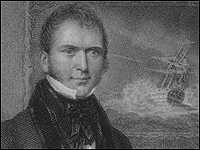
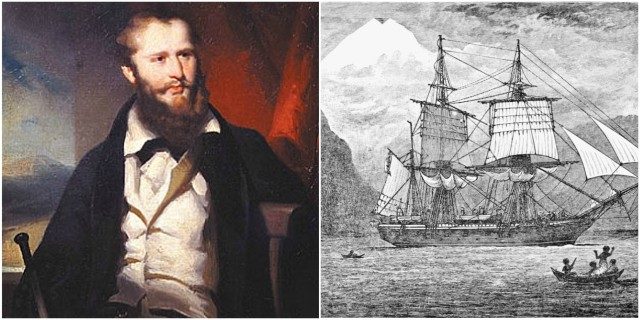
Left: A young James Holman from his naval days (courtesy of NPR). Right: A mature Holman with a full-grown beard (courtesy of Vintage News).
His first foreign travels took him to France. With little money, unable to speak the native language, and blind, Holman found his life’s purpose. His own words described his initial travels: “Behold me, then, in France! Surrounded by a people, to me, strange, invisible, and incomprehensible.”
By 1832, he had completed circumnavigation of the globe. By 1846, he had visited every inhabited continent. It was calculated that he traveled an estimated 400,000 kilometers. His metal-tipped walking stick was a constant companion.
Many adventures awaited Holman over the years. In Russia, he was imprisoned and later exiled as a spy. In Africa, he was involved in actions against the slave trade.
In his later years, Holman compiled memoirs of his travels. Five volumes would eventually be published, but most were not widely read.
Following his death in 1857, Holman’s life moved to obscurity. His adventures were long forgotten, but this would change.
In 2006, author James Roberts published a biography of Holman’s life and travels in A Sense of the World: How a Blind Man Became History’s Greatest Traveler.
People once again discovered the man known as the “Time Traveler.”
For more details about Holman’s extraordinary life, here is a link to more: Explorers Web.
This informative post will be posted on Saturday along with my usual writing. You are invited to participate with the opening question.
Brain Teaser Question
If a doctor gives you three pills, telling you to take one very half hour, how many minutes will pass from taking the first pill to the last pill?
(answer found at the end of this post)
Featured Facts
The Cornhusker State of Nebraska entered the American Union on March 1, 1867. Following the end of the American Civil War, the Nebraska Territory was the first one granted admission to statehood.
While the city of Omaha has been the most populated one in the state, Lincoln has been the capital city. According to the 2022 U.S. Census, Omaha’s population stood at 486,051 while Lincoln’s was 291,082.
Here are a few interesting facts about Nebraska:
State Bird: Western meadowlark
State Flower: Goldenrod
State Motto: Equality Before the Law
Chimney Rock, located in northwestern Nebraska at Deadwood Gulch, was one of the most noted landmarks on the Oregon Trail. The Nebraska Legislature has been the only one in the United States to use a single house chamber (unicameral). The original nickname for the state was the “Tree Planter’s State.”
Left: Chimney Rock. Right: The football Cornhuskers’ Memorial Stadium on the University of Nebraska campus. (Courtesy of Pinterest)
History repeat itself, but human nature remains the same.
There is no communication in this world except between equals.
Ken Burns (born 1953) is an American filmmaker who specializes in documentaries about American history and culture. Many of his works have been presented in PBS.
Opened in 1927, the LeVeque Tower was the tallest skyscraper between New York City and Chicago. Located in Columbus, Ohio, this impressive Art Deco building still highlights the skyline of the city.
At a height of 555 feet (intentionally designed to be five inches taller than the Washington Monument), the tower contains 47 stories. At the time of its completion, it was the fifth tallest building in the United States. Built upon a series of underground caissons, the foundation of the building is secured in the bedrock far below the city streets.
The LeVeque Tower has been called many names over the years. Its original name was the American Insurance Union Citadel. However, during the Great Depression years, the company went bankrupt. In the 1930s, the tower was nicknamed the “IOU Tower” because of the financial challenges it faced.
The Leveque Tower shows its classical Art Deco design. (courtesy of Pinterest)
In 1946, the tower acquired a new name of Lincoln-LeVeque Tower, which reflected its new owners, Leslie LeVeque and John Lincoln. In 1977, the building’s name was shortened to LeVeque Tower.
The tower remained the tallest building in Columbus until 1974 when the Rhodes State Office Tower (624 feet tall) was completed. The tower still stands as the second tallest building in the city.
In 1989, floodlights were added to illuminate the upper floors of the tower. The lights are used 6-8 times per year for special events such as: pink for Susan G. Komen For the Cure; red, white, and blue for Independence Day; and red and green for the Christmas season.
Today, the LeVeque Tower is a mixed-use building. It contains a hotel, condominiums, offices, and restaurant. The adjacent Palace Theater’s marquee and lobby are part of the tower.
Colorful floodlights illuminate the tower, and the grandeur of the Palace Theater’s grand staircase shines. (courtesy of Pinterest)
This informative post will be posted on Saturday along with my usual writing. You are invited to participate with the opening question.
Brain Teaser Question
Complete the analogy:
MOTH is to CLOTHING as . . .
(A) SHEEP is to WOOL
(B) BUTTERFLY is to WOOD
(C) PUNCTURE is to TIRE
(D) TEAR is to SWEATER
(E) TERMITE is to HOUSE
(answer found at the end of this post)
Featured Facts
The Buckeye State of Ohio was admitted to the Union on March 1, 1803. The state has proudly claimed to be home of eight American Presidents: William Henry Harrison, Ulysses S. Grant, Rutherford B. Hayes, James A. Garfield, Benjamin Harrison, William McKinley, William Howard Taft, and Warren G. Harding.
Here are a few interesting facts about the state:
Motto: With God, All Things Are Possible
Capital City: Columbus (named after Christopher Columbus)
Lake Erie frames the northern border; the Ohio River marks the southern one
In the early 1900s, the Canton Bulldogs were organized as a professional football team. While the team no longer exists, Canton became the home of the Pro Football Hall of Fame in 1963. Two major amusement parks are located in the state: King’s Island near Cincinnati; Cedar Point along Lake Erie at Sandusky.
Pro Football Hall of Fame and King’s Island. (courtesy of Pinterest)
Answer to Brain Teaser Question
E
A moth, which is a living thing, destroys clothing–just as termite, which is a living thing, destroys a house. Choices C or D would be fine if they described living things.
This informative post will be posted on Saturday along with my usual writing. You are invited to participate with the opening question.
Brain Teaser Question
Find the next letter in the sequence: a b d g k ?
(A) m (B) n (C) o (D) p (E) q
(answer found at the end of this post)
Featured Facts
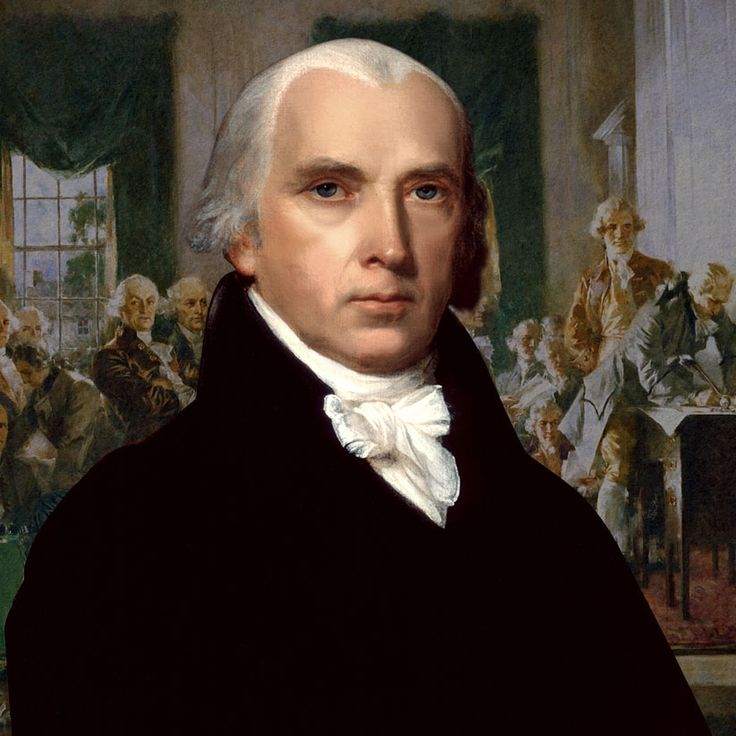
The fourth President of the United States was James Madison (1809-1817). He has often been referred to as “The Father of the Constitution.”
Born in the Virginia colony in 1751, Madison was destined to be a farmer and later a politician. He would die at his home at Montpelier, Virginia in 1836.
Here are some interesting facts about Madison:
He was the shortest President, standing only 5′ 4″.
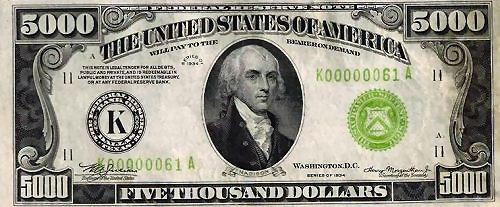
His portrait was used on the $5,000 bill, which was only issued during the American Civil War.
His spouse, Dolley, was instrumental in saving a portrait of George Washington when the British attempted to burn down the White House during the War of 1812.
During the ratification period of the Constitution in 1787-1788, James Madison was instrumental in writing numerous articles in support of it. He was joined in this endeavor by Alexander Hamilton and John Jay. These many writings were called the “Federalist Papers.”
This informative post will be posted on Saturday along with my usual writing. You are invited to participate with the opening question.
Brain Teaser Question
What’s the answer when you divide 40 by 1/2 and add 20? Try it without a calculator if you dare!
(answer found at the end of this post)
Featured Facts
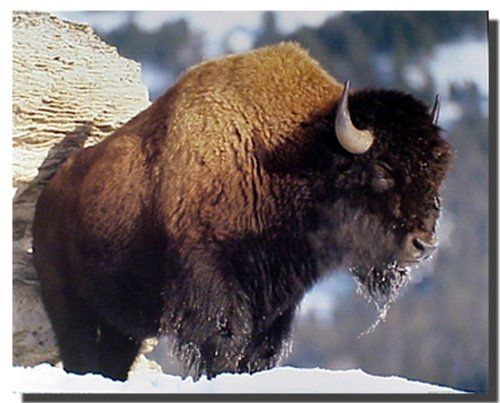
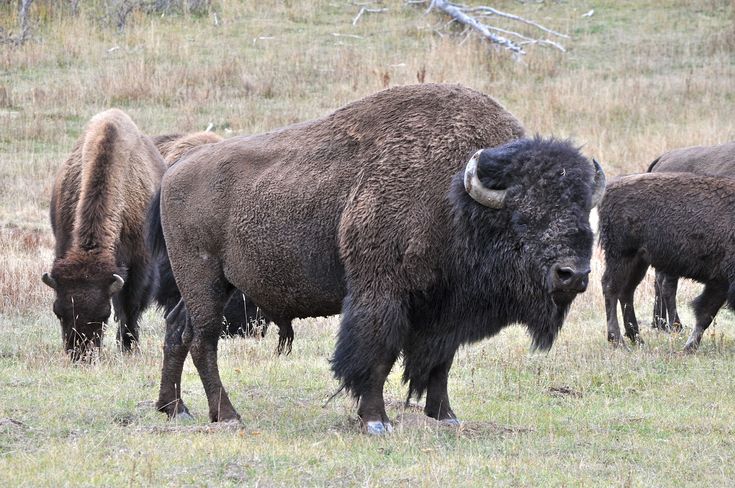
The American bison once roamed the Great Plains and prairies of North America in unbelievable numbers. Estimates run between 40 and 60 million bison. Today, approximately 350,000 bison inhabit the region.
Bison are frequently called buffaloes, but this term is meant for bovines inhabiting Africa and Asia. With a height of 5-6 feet, length of 7-11 feet, and weight up 2,000 pounds for bulls, they are the largest land mammal in North America.
Here are a few more interesting details about bison:
Sheds its thick, shaggy mantle in the spring.
Due to nearsightedness, vision is poor, but retains keen senses of smell and hearing.
Average life span runs between 12 and 20 years.
Today, nearly 30,000 wild bison are located on national parks and wildlife reserves. Yellowstone National Park is home to nearly 5,500 in two large, migrating herds. Ranches contain over 300,000 animals, who are treated more like livestock.
Both photographs were taken in Yellowstone National Park (courtesy of Pinterest).
Answer to Brain Teaser Question
100
Watch what you are dividing. You’re not dividing by 2, you are dividing by 1/2. Remember your basic skills. Dividing by 1/2 is like multiplying by 2.
This informative post will be posted on Saturday along with my usual writing. You are invited to participate with the opening question.
Brain Teaser Question
Complete the analogy: HELMET is to HEAD as . . .
a) SWORD is to WARRIOR
b) UMBRELLA is to CLOTHING
c) SHOE is to SOCK
d) WATCH is to WRIST
e) THIMBLE is to FINGER
(answer found at the end of this post)
Featured Facts
Astronauts have been called the sailors of the stars. For as long as people have gazed up into the heavens, they have dreamed of traveling in space.
In 1961, the first people journeyed from Earth’s atmosphere into outer space. The space race between the United States and the USSR (Union of Soviet Socialist Republics) was on.
The following list offers “firsts” in terms of space travel:
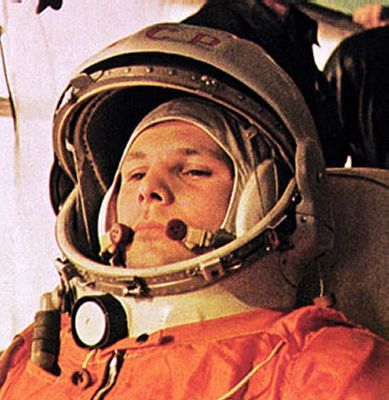
First man in space: Yuri Gagarin (USSR), 1961.
First American in space: Alan Shepard, 1961.
First to orbit Earth: John Glenn (USA), 1962.
First woman in space: Valentina Tereshkova (USSR), 1963.
First walk in space: Alexei Leonov (USSR), 1965.
First to orbit the Moon: Frank Borman, James Lovell, William Anders (USA), 1968.
First walk on the Moon: Neil Armstrong and Edwin “Buzz” Aldrin (USA), 1969.
First American woman in space: Sally Ride, 1983.
Cosmonaut Yuri Gagarin and astronaut Alan Shephard. (Courtesy of Pinterest)
Answer to Brain Teaser Question
E
A helmet is worn on the head to protect the head, just as a thimble is worn on a finger to protect the finger.






 Big Sky Buckeye