Anything can be achieved with a good, healthy dose of courage.
Relationships change us and make us grow.
Viola Davis (born 1965) is an American actress and film producer. She is one of a handful of performers to have earned an Academy Award, an Emmy Award, a Grammy Award, and a Tony Award.
Experiencing personal triumph at the 1936 summer Olympics in Berlin, American Jesse Owens exhibited a resolute attitude and perseverance to overcome many challenges.
Born in Oakville, Alabama in a sharecropper’s cabin in 1913, Owens experienced poverty and racial inequality during his early years. During the Great Migration, his family found a home and better opportunities in Cleveland, Ohio.
left: Owens during his time as a member of the ohio state track team. right: Owens childhood home in cleveland, ohio. (Courtesy of pinterest)
Life’s stage was set for Owens to become the first Olympian to ever win four gold medals in a single Olympiad. As the final pieces of his life’s journey began falling into place, the relationships in his life helped to lead him to further greatness.
Track and field offered a unique opportunity to run for freedom in an integrated environment. Inspired by his high school coach, Charles Riley, Owens won all major track events and was an Ohio state champion three years in a row.
In 1933, Owens enrolled at Ohio State University, which was well-known for its tremendous track and field program. Under Larry Snyder’s coaching, Owens continued to mature as a sprinter and jumper.
left: coach charles riley with owens. right: later in life, owens with coach larry snyder. (courtesy of Pinterest)
Meanwhile in Germany, the Nazi regime radically altered the landscape with its Nuremburg Laws, which limited the rights of the Jewish population. Owens and German Fuhrer, Adolf Hitler, were headed on a collision course.
As America contemplated a possible boycott of the 1936 summer Olympics, Owens’ mentors encouraged him to stand tall in his desire to compete in the games. In hindsight, many saw the contrast of German Aryan race superiority and anti-Semitism with America’s own inequality and Jim Crow laws that faced many of the Black population. Owens became a light in the darkness lived by many.
Owens’ journey brought him and America respect internationally. Nazi propaganda failed to experience a victory at every Olympic event, and Owens’ exploits led the way.
He earned four gold medals in a single Olympiad with victories in the 100 meters, 200 meters, long jump, and 4 x 100 meter relay. The long jump competition infused Owens with a final relationship to cultivate.
In the trials of the long jump, each competitor received three jumps in order to qualify for the finals. Owens scratched on his first two attempts, and he faced one final attempt in order to make the final field of jumpers.
His primary German competitor, Luz Long, offered him a tip to move his take-off point well behind the board. Long’s wisdom restored confidence in Owens before he made his final jump, and he easily qualified for the finals.
Despite Long being German and Owens being American, both felt a bond. While Long settled for a silver medal in the long jump, he gained a friend in Owens. Both athletes found a reward far greater than medals and competition. Their relationship exceeded the drama which surrounded the games.
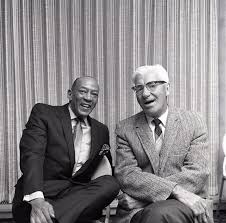
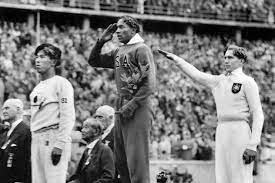
LEFT: the american national anthem plays after owens receives his gold medal in the long jump, german COMPETITOR luz long is pictured to owens’ left. right: long and owens later during the 1936 games. (courtesy of pinterest)
You’ve got to get up every morning with determination if you’re going to go to bed with satisfaction.
Never ask a man what he knows, but what he can do.
George Lorimer (1867-1937) was an American author, journalist, and publisher. One of his most enduring accomplishments was editing THE SATURDAY EVENING POST from 1899 to 1936.
There is no finish line. When you reach a goal, find a new one.
A lot of times people look at the negative side of what they feel they can’t do. I always look on the positive side of what I can do.
Chuck Norris (born 1940) is an American actor and martial artist. After serving in the United States Air Force, he won numerous championships in martial arts competitions. Later, he becomes a highly successful actor in film and television.
Success is not the result of spontaneous combustion. You must set yourself on fire.
Courage is doing what you’re afraid to do. There can be no courage unless you’re scared.
Eddie Rickenbacker (1890-1973) was an American combat pilot, race car driver, and business executive. Born in Columbus Ohio, he became America’s top flying ace during World War I.
Even a child is known by his doings, whether his work be pure, and whether it be right.
Let us then be up and doing, with a heart for any fate; still achieving, still pursuing, learn to labor and to wait.
Henry Wadsworth Longfellow (1807-1882) was an American poet and educator. Born in Portland, Maine, he has long been remembered for being one of New England’s fireside poets.
A leader takes people where they want to go. A great leader takes people where they don’t necessarily want to go, but ought to be.
If you doubt you can accomplish something, then you can’t accomplish it. You have to have confidence in your ability, and then be tough enough to follow through.
Rosalynn Carter (1927-2023) served as First Lady during her husband’s term of office as American President (1977-1981). Involved with many accomplishments, she and Jimmy Carter were lifetime partners. She was a devoted and tireless advocate for greater awareness of mental health and other humanitarian causes.
From James 1:12: “Blessed is anyone who endures temptation. Such a one has stood the test and will receive the crown of life that the Lord has promised to those who love Him.”
Edmund Burke (1729-1797) was an Anglo-Irish statesman, economist, and philosopher. He served in the British House of Commons from 1766-1794.














 Big Sky Buckeye