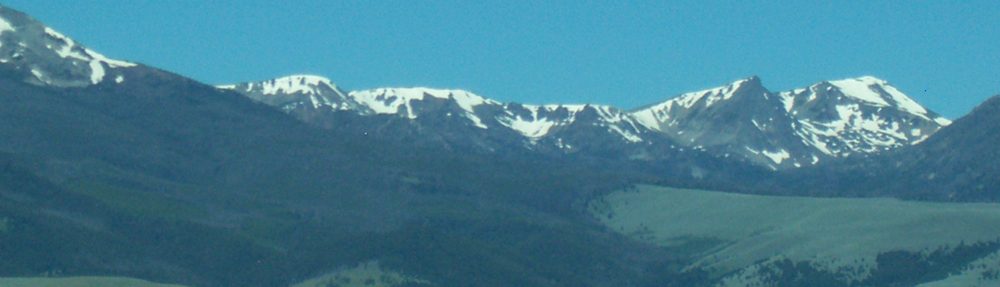
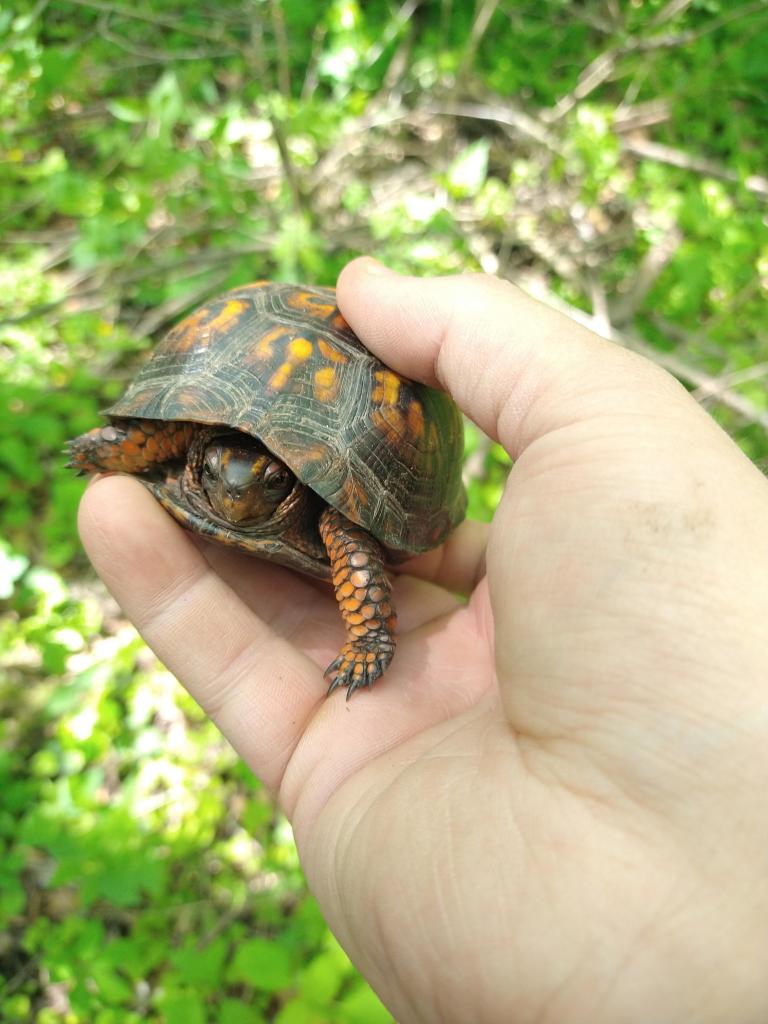
The Buckeye state of Ohio offers a landscape filled with quite a diversity of wildlife. Two of its more unique creatures include the black squirrel and eastern box turtle.
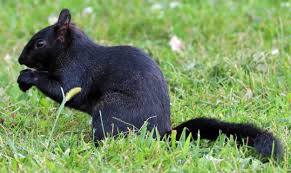
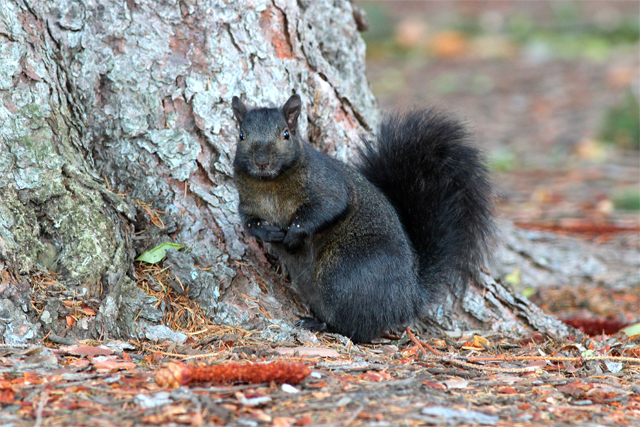
The black squirrel is of the same species as the eastern gray squirrel. Its distinct black outer coat has evolved because of a mutation in a genetic trait called melanism. This increase in dark pigment results from an increase of eumelanin production.
Some distinctive characteristics of a black squirrel include:
- Weight: between 14-21 ounces
- Length: 18-22 inches (including the tail)
- Habitat: concentrated in urban and suburban environments
A black squirrel finds readily available food sources in habitats with mature trees such as oak, hickory, maple, and walnut. Each thrives in a human-dominated landscape, where its dark outer color blends with shaded areas. Trees with a dense canopy provide shelter from predators and weather extremes.
For nesting and shelter, a black squirrel may utilize manmade structures, such as attics, chimneys, and sheds.

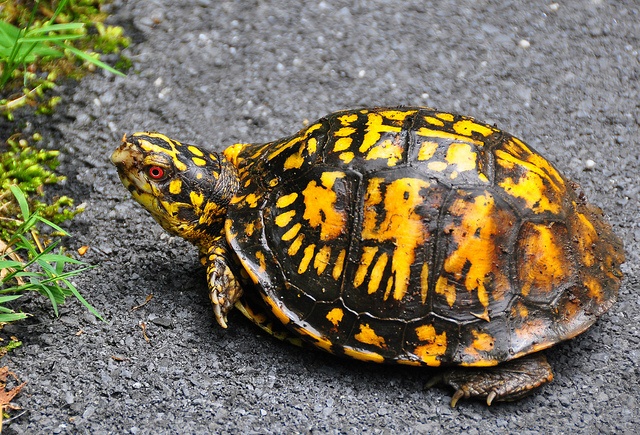
The eastern box turtle lives a less active and more isolated existence than the black squirrel. This turtle acquires its name from its centrally hinged lower shell which allows it to draw more tightly against the upper shell. A more effective protection is provided for the turtle.
Some unique characteristics of an eastern box turtle include:
- Lifespan: 50 to 100 years
- Size: between 5-7 inches
- Diet: omnivorous (meat, insects, fruits, vegetables)
An eastern box turtle stands out with the high-domed carapace of its upper shell. The base color is usually dark brown or black with a wide variety of markings. The shell is accented with streaks and blotches of yellow. Some shells may display colors of orange or red.
Being terrestrial, this turtle is quite comfortable living on land in open woodlands. During the summer heat, it will lie hidden beneath rotting logs and decaying leaves. Only in the coolness of early morning and evening will the eastern box turtle venture out.
During its reproduction cycle, incubation of 3-8 eggs lasts about three months. This usually occurs between May and July.


 Big Sky Buckeye
That little box turtle is adorable. I always get a kick out of seeing turtles in the wild, although I most often see red-eared sliders around the water. We have a black squirrel in Texas that’s a different species; it’s commonly called a rock squirrel. It doesn’t live in my area; it tends to prefer the woods and cliffs of areas farther west in the state.
I didn’t know that the box turtle’s name comes from its way of closing its shell. Very interesting!
LikeLiked by 3 people
Linda, I appreciate your response. I agree that the tiny box turtle is adorable . . . it made a delightful opening photo. I haven’t seen a black squirrel, but some of my research stated that they like to hang out in mature, urban woods. Kent State University and Ohio State University are possible sights.
LikeLiked by 1 person
Informative and interesting! I’ve never seen a black squirrel but we have plenty of box turtles in Virginia.
LikeLiked by 1 person
Vickie, I appreciate your feedback. I’ve never seen a black squirrel, but I’ve read that several inhabit the urban woods near The Ohio State University.
LikeLiked by 1 person
My husband attended Kent State University and that’s where residents claim black squirrels originated. Interesting animal info-thanks! 🙂
LikeLiked by 1 person
Nancy, thank you for sharing Kent State and black squirrels. In my research, I did find some interesting tidbits about college life and this precious squirrel.
LikeLiked by 1 person