
This informative post will be published on Saturday in place of my regular one. You are invited to participate with the opening question.
Brain Teaser Question
If you multiply this number by any other number, the answer will always be the same. What number is this?
(answer found at the end of this post)
Featured Facts
Following Abraham Lincoln’s assassination, Andrew Johnson was sworn in as the 17th President of the United States in April, 1865. He would serve one term in office until 1869.
Here are a few quick facts about “The Father of the Homestead Act”:
- State represented: Tennessee
- Occupation: Tailor
- Life span: 1808-1875
- Other elected offices: Governor, U.S. Congress (both in the House and Senate)
- Notable achievements as President: in 1867 purchase of Alaska from the Russian Empire; in 1865 ratification by the states of the 13th Amendment to the U.S. Constitution (abolishing slavery)
Like his predecessor, Abraham Lincoln, Johnson was a self-educated man. He became a highly popular politician in Tennessee.
Johnson, a southern Democrat, chose to support the Union when the Civil War broke out. He was the only southern Senator to remain at his post when most of the South, including his home state of Tennessee, seceded from the Union.
Johnson supported proposed legislation for the Homestead Act in the late 1850s. While most Democrats were against the bill, he remained a strong advocate. Eventually the legislation passed Congress and was signed into law by President Lincoln in 1862.
With the approaching election of 1864, President Lincoln felt that he would need to broaden his support with others outside of his Republican Party. His party chose Tennessee Democrat Johnson to join the ticket as the candidate for Vice President. The juggernaut of Lincoln and Johnson easily won election, and Lincoln’s victory insured that he would be the first incumbent to win a second term since Andrew Jackson in 1832.
Of course, fate intervened in April, 1865. Upon assuming the Presidency, Johnson attempted to follow Lincoln’s moderate plan for Reconstruction after the Civil War. Johnson ran into stiff resistance from the Radical Republicans in Congress. Eventually Johnson faced more and more opposition, which led the U.S. House of Representatives to approve the first impeachment of an American President in 1868. Fortunately for Johnson, he narrowly escaped conviction in the U.S. Senate by one vote.
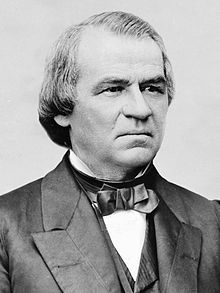


OFFICIAL portrait of Johnson as President, election of 1864 poster with Lincoln and Johnson (take note of the party label of “National Union”), Johnson’s home in Greeneville, Tennessee. (Images courtesy of Pinterest)
Answer to Brain Teaser Question
Zero
 Big Sky Buckeye