

This informative post will be published on Saturday in place of my regular one. You are invited to participate with the opening question.
Brain Teaser Question
Throw away the outside and cook the inside; then eat the outside and throw away the inside. What is it? (Hint: delicious with extra butter)
(answer found at the end of this post)
Featured Facts
The most common of all deer species in the United States is the white-tailed deer. Sometimes they are referred to as whitetail deer or Virginia deer.
Here are a few quick facts about the white-tailed deer:
- Height (at shoulder): 2.5 to 3.5 feet
- Weight: bucks (males), 200-300 pounds; does (females), 100-200 pounds
- Average lifespan: around 10 years
White-tailed deer live throughout the continental United States. They can be found in a variety of habitats: open wooded areas, wetlands, meadows, and prairies. Their diet consists of grasses, leaves, twigs, fruit, flowers, lichen, and legumes (such as alfalfa and clover). Their four-chamber stomach allows them to eat just about anything.
Throughout most months, white-tailed deer feature a reddish-brown coat. This changes to grayish-brown during the late fall and winter. For short distances, they are able to run up to 30 miles per hour, and many can jump fences nearly eight feet tall.
Being one of the smallest deer in the United States, the white-tailed species differs from its larger cousin, the mule deer. Most mule deer are found in the western United States, and there are slight differences in physical characteristics. Bucks usually weigh 400 pounds or more. They also possess larger ears and antlers.
The chief predator of white-tailed deer is man. However, it is also pursued by natural predators in the wild. These animals may include the cougar, wolf, bear, mountain lion, and coyote.
Does typically give birth to two or three fawns. They are easily identified by the spots found on their bodies. Fawns will usually be nursed for 8-10 weeks. Young bucks will stay with their mother for about one year while young does will stay for nearly two years. Most mature bucks live a solitary life, and they will only gather around does during the fall breeding season.
Many people have read Hungarian-born, Austrian writer Felix Salten’s novel from 1922, Bambi, a Life in the Woods. Salten uses a European setting so the deer in his writings is a roe deer. This differs from the deer used in the Disney animated film from 1942, “Bambi.” Here an American white-tailed deer is featured.


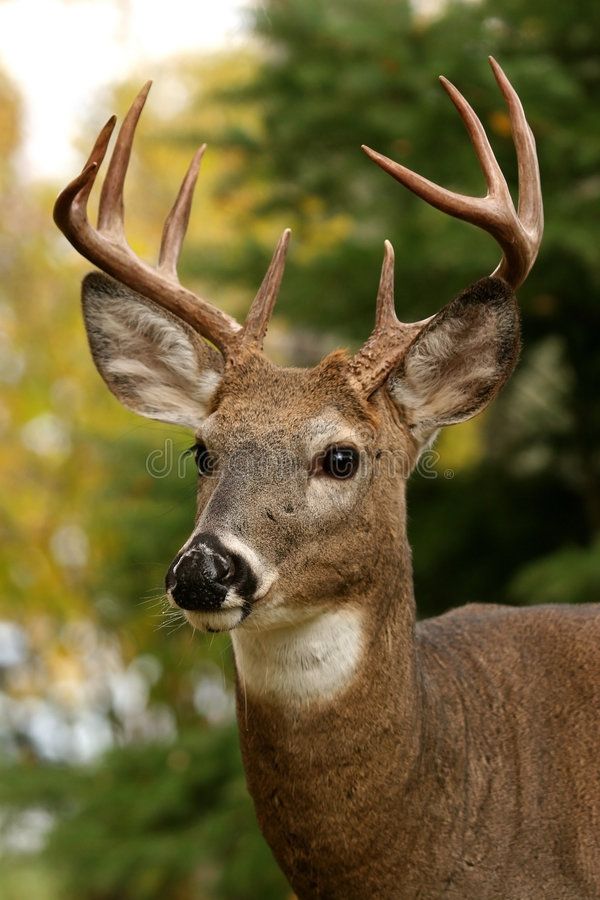
top left and moving clockwise: mature white-tailed buck, white-tailed fawn, white-tailed doe, roe deer buck (European), another white-tailed buck (notice the smaller size and more narrow spread of the antlers), mule deer buck (notice the larger size and wider spread of the antlers), two white-tailed bucks fighting over a female during the autumn breeding season. (Images courtesy of Pinterest)
Answer to Brain Teaser Question
Corn on the cob.
 Big Sky Buckeye