

This informative post will be published on Saturday in place of my regular one. You are invited to participate with the opening question.
Brain Teaser Question
I have two coins that add up to 30 cents (in U.S. money), and one of them isn’t a nickel. What are the two coins?
(answer found at the end of this post)
Featured Facts
One of nature’s most intriguing creatures is the diminutive salamander. In the state of Ohio, there are 24 different species.
Here are a few interesting facts about the salamanders found in the Buckeye State:
- Classification: Amphibian
- Physical features: Smooth, moist skin without scales or claws; delicate and small; variety of colors
- Habitat: Many prefer inland bodies of water (ponds and streams) while others are more suited to moist conditions on land (terrestrial)
These long-tailed amphibians are cousins of frogs and toads. Their main sources of food include invertebrates: insects, slugs, worms, leeches, and snails. They are preyed upon by fish, birds, otters, snakes, turtles, muskrats, raccoons, and skunks. A salamander’s body coloration helps it hide from those seeking to prey upon it.
Salamanders also face threats from disease, pollution, loss of habitat, and non-native invasive species. The human handling of any salamander in Ohio is prohibited by law. From spring to mid-summer during breeding season, they are quite active at night.
One of the largest salamanders found in Ohio is the Eastern Hellbender. Its average length runs between 12-24 inches. Their territory is located in the southern and eastern regions of the state. Its preferred habitat is a swift-flowing stream where they can hide under rocks during the daytime.

One of Ohio’s most common salamanders is the Northern Dusky. It lives everywhere in the state except for the northeastern region. Its average length is 3-5 inches. A light line extends from the back of the eyes to the back of the mouth.

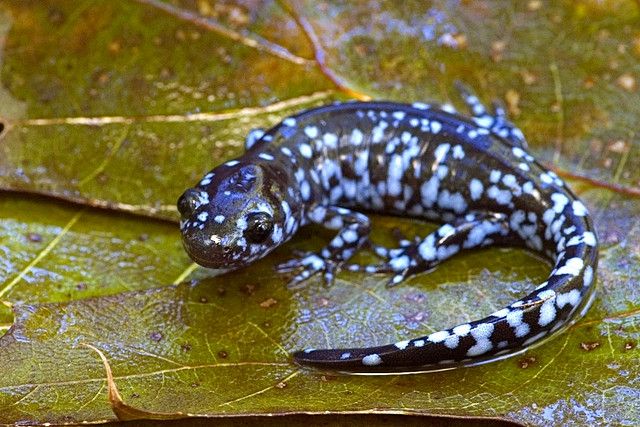
One of the smallest salamanders in Ohio is the Blue Spotted species. It is found in most areas of the Buckeye State. Being about 2 inches in length, its body shows off a distinct pattern of contrasting spots.
The final species to present is one of Ohio’s terrestrial salamanders. The Redback spends much of its life on land. With a length of 2-4 inches, it is found throughout the state. During breeding season, eggs are placed under moist rocks and under logs. During the arrival of early spring, people may discover a Redback peeking out beneath rocks and logs.

Answer to Brain Teaser Question
A quarter and a nickel (the quarter isn’t a nickel).
 Big Sky Buckeye