
This informative post will be published on Saturday in place of my regular one. You are invited to participate with the opening question.
Brain Teaser Question
When my dad was 31, I was just 8 years old. Now his age is twice as old as my age. What is my current age?
(answer found at the end of this post)
Featured Facts
The United States is home to three types of vultures. These carnivorous birds of pray live a life of consuming carrion, which is decaying flesh of dead animals.
Here are the types of vultures and their territorial range:
- Turkey Vulture: virtually every region of the country
- Black Vulture: predominately in southeastern region of the country
- California Condor: selected areas of California and Arizona
The Turkey Vulture is the most common species in the United States. Its appearance features an all black body, bald head, and pinkish bill. They possess a highly developed sense of smell, which allows for easier detection of carrion up to eight miles away. Lacking vocal cords, these birds can only make a “hissing” sound.
The Black Vulture is covered in black feathers, bald head with black skin, and wings with silver feathers on the underside. They possess excellent vision, and they prefer killing small animals (skunks, opossums, baby pigs, calves, and lambs) for food instead of carrion. They follow a habit of staying close to Turkey Vultures, who have a better sense of small. Since Black Vultures are more aggressive, they frequently chase their competition away.
The California Condor is the largest bird in the United States. With a predominately black body and wings, the underside of the wings is usually white. The bald heads range in color from yellow to orange to pink to purple to blue to red.
In 1987, the Condor is declared extinct in the wild. The few remaining birds live in captivity. Because of a very successful breeding program, Condors are released back into the wild in California (1991) and Arizona (1996). The Condor has excellent gliding skills when in flight, and they can soar as high as 15,000 feet.
All three of these raptors feature featherless heads and necks. This helps to keep the birds clean while consuming carrion. A powerful stomach acid protects each bird of prey from exposure to rabies, Black Plaque, botulism, distemper, and anthrax.
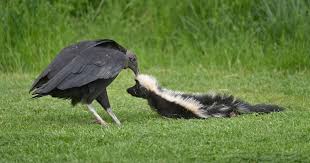
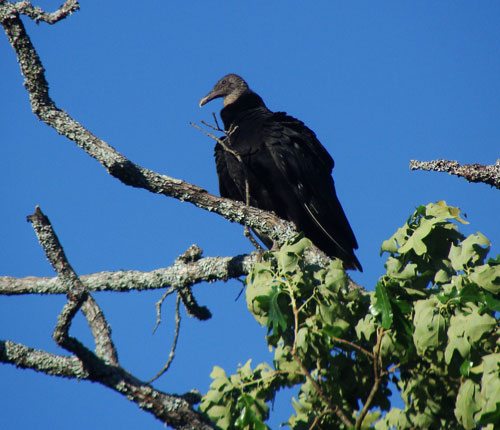


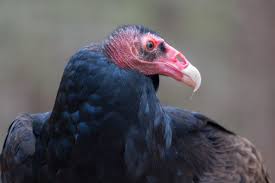


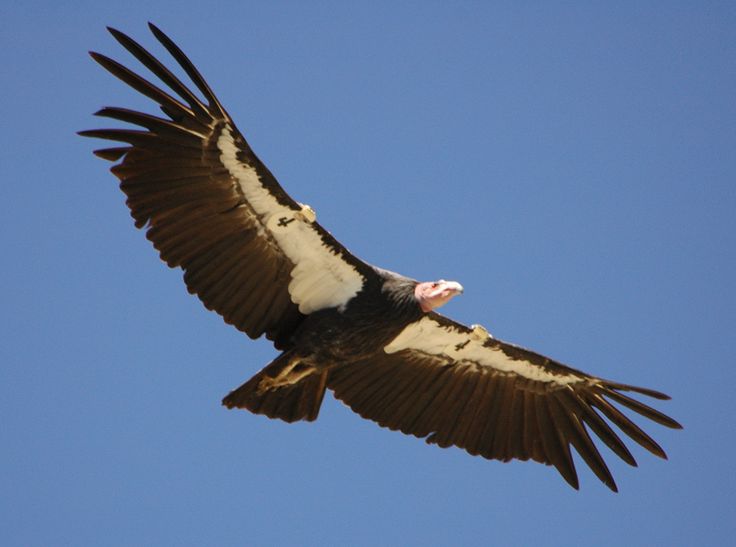
row 1: black vultures feasting, in flight, and looking for prey. Row 2: Turkey Vultures on left column, along with baby chick. on the right column, california condor with handler (notice the size contrast). row 3: california condor in flight. (all images courtesy of PINTEREST)
Answer to Brain Teaser Question
23 years old.
 Big Sky Buckeye
Not sure how I got the brain teaser but I did. Wow! Math so early in the morning. I like your turkey vulture photos but I am not a fan since I think they are big and ugly. My husband says that they are God’s clean up crew and I think he’s right.
LikeLiked by 2 people
Vickie, congratulations on solving the brain teaser. I like Harry’s perspective on a vulture’s contribution.
LikeLiked by 1 person
You got me with this brain teaser. I didn’t know how to approach it, and even after I read the answer I couldn’t figure it out. No matter. My frustration was completely assuaged by that photo of the vulture chick. I’ve never seen one before, and it’s completely adorable. We have both Turkey and Black vultures, and it’s fascinating to see the similarities and differences between them. Thank goodness we have them; without their efforts, it would be a messier world.
LikeLiked by 1 person
Linda, thank you for sharing your perspective about vultures. They certainly have a defined role in the food chain.
LikeLiked by 1 person
The different kinds of vultures and their eating habits is quite interesting. The reason for their bald heads and powerful stomach acids particularly fascinating. Thanks! 🙂
LikeLike
I had an idea for a solution to your brain teaser but I had to play it out on a spreadsheet, lol.
LikeLiked by 1 person
Awesome! It’s been awhile since I broke out a spreadsheet. I used to teach students how to apply it to find answers.
LikeLiked by 1 person
Fascinating I didn’t know there were three types of vultures in the US
LikeLike