
This informative post will be published on Saturday in place of my regular one. You are invited to participate with the opening question.
Brain Teaser Question
There is a house. A person enters this house blind to most of the world’s knowledge, but exits it seeing so much more of it. What is it?
(answer found at the end of this post)
Featured Facts
One of the most fascinating insects is the quiet and elusive walking stick, who is one of the largest insects in the world.
Here are a few quick facts about the walking stick:
- Size: varies with an average range of 1-12 inches in length
- Color: light to dark brown
- Diet: primary food is leaves (herbivores)
- Habitat: woods, forests, grasslands
Living in temperate and tropical climates, the walking stick is a member of the Phasmida family of insects. With more than 3,000 species, they live on every continent except Antarctica.
The walking stick’s name is quite descriptive as it looks very much like a thin twig. This long insect features slender legs and antennae. They have the ability to regenerate a lost leg.
Since each resembles a narrow twig, the walking stick is blessed with a well-camouflaged appearance. They hide in plain sight, and few predators notice them. One of the most successful predators is the bat, which is equipped to hunt by echolocation. Bats use a biological sonar system to help locate their prey.
The life cycle of the walking stick begins with a female laying dozens of seed-like eggs. Eggs are dropped to the ground, one at time. Some eggs may take up to two years to hatch. Nymphs look like tiny adults, and they will reach full maturity in about 3-12 months. The average lifespan of a walking stick is two years.
An unusual trait of walking stick reproduction is what happens when a male is not present to mate. Females lay their eggs, which will only bear female offspring. This phenomena is called parthenogenesis.


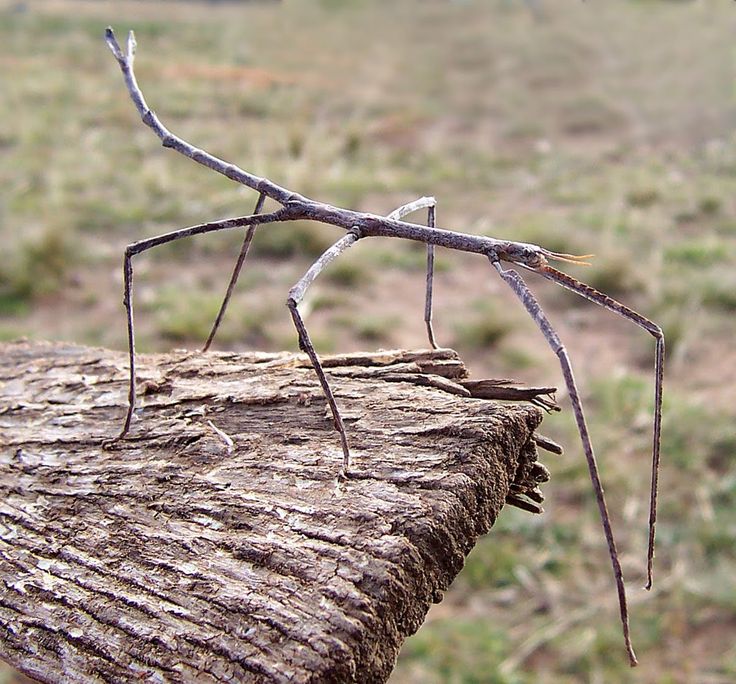

top left and moving clockwise: notice the length of a walking stick in contrast with a human hand, movement over a rocky formation, walking upon a piece of wood, can you see the camouflaged walking stick in this final photo? (Images courtesy of Pinterest)
Answer to Brain Teaser Question
A schoolhouse.
 Big Sky Buckeye