
This informative post will be published on Saturday in place of my regular one. You are invited to participate with the opening question.
Brain Teaser Question
A plane crashed between the border of France and Belgium. Where were the survivors buried?
(answer found at the end of this post)
Featured Facts
The wild turkey of North America is a wary and magnificent bird. While domestic turkeys fulfill America’s demand for Thanksgiving dinners, the wild turkey freely intermingles with deer as they frequently share the same habitat.
Here are a few quick facts about the wild turkey:
- Habitat: woodlands, grasslands, swamps (prefer mixture of woodlands and open clearings)
- Wingspan: 4-5 feet
- Weight: male, up to 24 pounds; female, up to 12 pounds
- Diet: nuts, seeds, fruit, insects, small lizards (omnivorous)
- Lifespan: 3-5 years
One of the American Founding Fathers, Benjamin Franklin, is said to have preferred the turkey over the bald eagle as the nation’s choice of national bird. Of course, the eagle’s fortunes have soared while the turkey’s have stayed closer to home.
Turkeys are found in nearly every region of the the lower 48 states of the United States. Conservation efforts have allowed the turkey population to recover from reduced numbers because of hunting and loss of habitat. In the early 1900s, roughly 200,000 turkeys roamed America’s woodlands and grasslands. Today, their number has ballooned to 6-7 million.
Sometimes nicknamed the “bird of courage,” the turkey is a related species to the ring-necked pheasant. There are five subspecies of turkeys in North America: Eastern, Osceola, Rio Grande, Merriam’s, and Gould’s.
Turkeys are not migratory, but they may wander during the autumn season. They are most active in foraging during the early morning and evening. Their nests consist of shallow dirt depressions, surrounded by vegetation. Natural predators of the turkey include coyotes, bobcats, mountain lions, Golden Eagles, and Great Horned Owls. Turkeys must defend their nests from other predators, including raccoons, opossums, skunks, snakes, foxes, and woodchucks.
A male turkey features more colorful and distinctive features than a female. Their distinctive red wattle hangs from the beak, and a dark tuft of feathers covers the breast. A female’s colors are more muted, subtle, and duller.
Turkeys will roost overnight in trees, which provide greater protection from predators. Mature turkeys are capable to running up to 20-25 miles per hour, and they can fly short distances at speeds of 50-55 miles per hour.


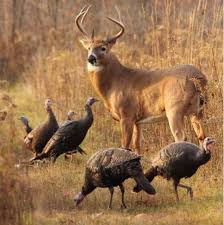
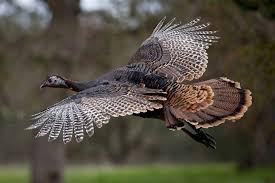
clockwise from top left: mature male in his colorful attire, female hen (note smaller size and more subtle colors), flock gathering, in flight to escape predator or seek SAFETY in tree, comfortable among deer’s presence, female with her brood. (Images courtesy of Pinterest)
Answer to Brain Teaser Question
They weren’t buried because survivors don’t need to be buried.
 Big Sky Buckeye